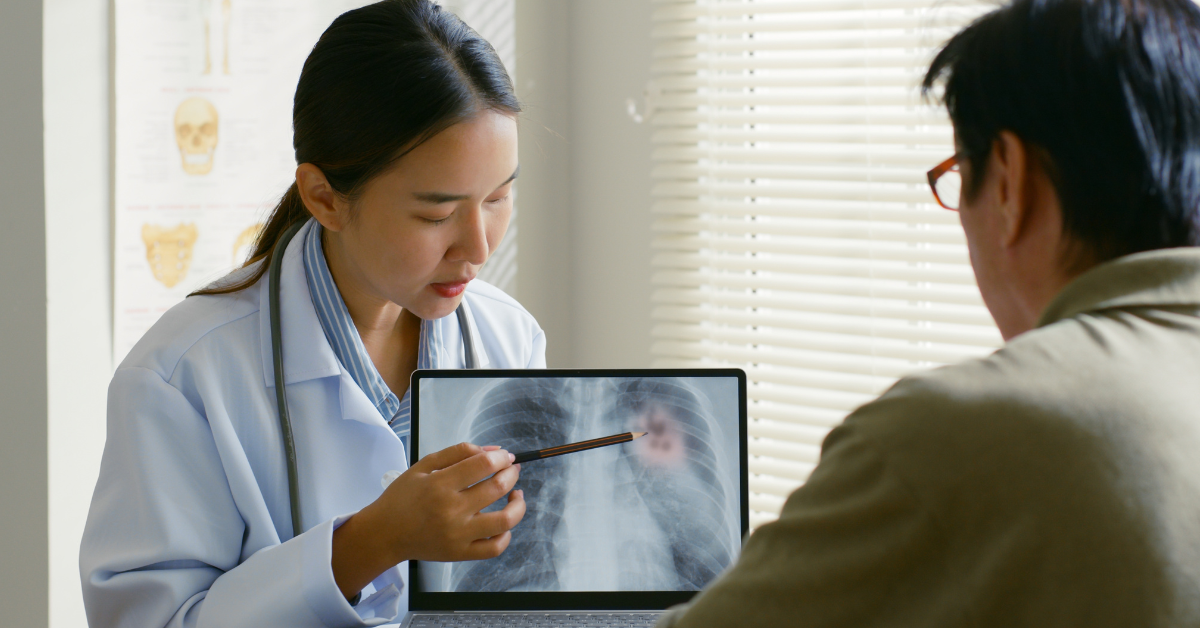
Lung cancer is one of the most common cancers worldwide, and one of the most deadly. Every year, hundreds of thousands of families are affected by this diagnosis, yet many people don’t realize that when and how lung cancer is detected can make the difference between survival and loss.1
That is why understanding the stages of lung cancer is not just a medical detail, it’s a roadmap for treatment, survival, and hope. For underserved communities, where barriers to care remain significant, staging becomes an even more critical conversation.
What Is Lung Cancer?
At its core, lung cancer begins when abnormal cells in the lungs grow uncontrollably, forming tumors that interfere with breathing and oxygen exchange. The two main types are:
- Non-Small Cell Lung Cancer (NSCLC), which makes up about 85% of cases, tends to grow more slowly and is often more responsive to a wider variety of treatments.2
- Small Cell Lung Cancer (SCLC), making up about 15% of cases, is aggressive, spreads quickly, and usually requires chemotherapy and radiation rather than surgery.2
Understanding which type of lung cancer a person has is the first step before staging and planning treatment.
The Importance of Cancer Staging
Staging is the process of determining how far the cancer has spread within the body.3 This information guides doctors in choosing the best treatment, whether that’s surgery, chemotherapy, radiation, targeted therapy, or a combination.
It also gives people diagnosed with the condition and their families a clearer picture of prognosis. Doctors use tools such as CT scans, PET scans, biopsies, and molecular testing to determine stage.3
Stages of Non-Small Cell Lung Cancer (NSCLC)
- Stage 0 (Carcinoma in Situ): Abnormal cells are found only in the lining of the lung. At this stage, the condition is highly curable.3
- Stage I: The tumor is small and confined to one part of the lung. It has not spread to lymph nodes. Surgery is often an option here.3
- Stage II: The tumor is larger or may have spread to nearby lymph nodes inside the lung, requiring combined treatments such as surgery and chemotherapy.3
- Stage III: The cancer has spread to lymph nodes in the chest or invaded nearby structures. Treatment often involves chemotherapy, radiation, and sometimes surgery.3
- Stage IV: The most advanced stage, where cancer has spread (metastasized) to distant organs such as the brain, bones, or liver. Treatments focus on control, quality of life, and extending survival.3
Stages of Small Cell Lung Cancer (SCLC)
Because it grows and spreads so rapidly, SCLC is staged differently:
- Limited Stage: The cancer is confined to one lung and nearby lymph nodes. It may be treatable with radiation and chemotherapy.4
- Extensive Stage: The cancer has spread widely, often to distant organs. While treatment can shrink tumors and improve survival, cure is much less likely.4
Why Early Detection Matters
Survival outcomes vary dramatically depending on stage. For example, individuals diagnosed at Stage I NSCLC may have a five-year survival rate above 60%. By Stage IV, survival drops to less than 10%.1
Early detection opens doors to curative surgery, targeted therapy, and clinical study opportunities. Unfortunately, many people are diagnosed late because early symptoms, such as a persistent cough, chest pain, unexplained fatigue, or weight loss, are easy to dismiss.1
Disparities in Lung Cancer Outcomes
For underserved communities, lung cancer outcomes are shaped by more than biology. Research shows that people of color and low-income populations are often diagnosed at later stages. Barriers like underinsurance, fewer cancer centers, and lack of access to low-dose CT screening contribute to these disparities.5
Layered onto this are social factors: mistrust in the medical system, delayed referrals to specialists, and cultural stigmas surrounding cancer that may prevent open conversations. All of these factors create a cycle where lung cancer is detected late and treatment options are limited.5
Call to Action: Closing the Gap
Breaking this cycle requires action on multiple fronts. High-risk individuals, especially those with a history of smoking or significant environmental exposure, should talk with their healthcare provider about screening. Communities need equitable access to specialists, early testing, and clinical studies. Most importantly, education and open dialogue are key to dismantling stigma and empowering people to seek help early.
Understanding the stages of lung cancer is more than medical knowledge, it’s empowerment. It equips families to ask the right questions, demand timely care, and advocate for better outcomes. For our underserved communities, where disparities are real but not inevitable, this knowledge becomes a tool for change.
With awareness, advocacy, and early detection, we can turn the tide and ensure that lung cancer is not an automatic death sentence, but a fight that can be faced with hope.
References
- ACS. (2024, January 29). Can Lung Cancer Be Found Early? Retrieved from American Cancer Society: https://www.cancer.org/cancer/types/lung-cancer/detection-diagnosis-staging/detection.html
- ACS. (2024, 29 January). What Is Lung Cancer? Retrieved from American Cancer Society: https://www.cancer.org/cancer/types/lung-cancer/about/what-is.html
- ACS. (2025, June 9). Non-small Cell Lung Cancer Stages. Retrieved from American Cancer Society: https://www.cancer.org/cancer/types/lung-cancer/detection-diagnosis-staging/staging-nsclc.html
- ACS. (2024, January 29). Small Cell Lung Cancer Stages. Retrieved from American Cancer Society: https://www.cancer.org/cancer/types/lung-cancer/detection-diagnosis-staging/staging-sclc.html
- ALA. (2024, November 13). Racial and Ethnic Disparities. Retrieved from American Lung Association: https://www.lung.org/research/state-of-lung-cancer/racial-and-ethnic-disparities